Material selection is one of the most critical decisions in wetsuit sourcing.
For brands, distributors, and private label buyers, the wrong material choice can lead to unstable quality, pricing issues, or poor market feedback. This article breaks down the four most commonly used wetsuit materials—and explains when to use each.
Why Wetsuit Material Choice Matters in B2B Sourcing
Wetsuit materials directly affect:
-
Thermal insulation
-
Flexibility and comfort
-
Durability and lifespan
-
Cost structure
-
Target market positioning
Material decisions should always align with price point and end-user expectations.
SBR Neoprene: Cost-Effective Entry-Level Solution
SBR (Styrene Butadiene Rubber) is widely used for entry-level wetsuits.
Advantages:
-
Lowest material cost
-
Stable supply
-
Suitable for beginners and rental markets
Limitations:
-
Lower elasticity
-
Reduced thermal efficiency
-
Shorter lifespan
Best for:
Entry-level brands, rental programs, promotional wetsuits.
SCR Neoprene: Balanced Performance & Cost
SCR (Styrene Chloroprene Rubber) blends SBR and CR properties.
Advantages:
-
Better flexibility than SBR
-
Improved insulation
-
Moderate pricing
Limitations:
-
Not as soft as full CR
-
Mid-range durability
Best for:
Mass-market retail wetsuits and value-focused private labels.
CR Neoprene: High Performance Standard
CR (Chloroprene Rubber) is the industry benchmark for performance wetsuits.
Advantages:
-
Excellent elasticity and comfort
-
Strong thermal retention
-
Long service life
Limitations:
-
Higher material cost
Best for:
Surf, diving, and professional-use wetsuits.
Limestone Neoprene: Premium & Eco-Focused Option
Limestone neoprene replaces petroleum-based inputs with limestone.
Advantages:
-
High stretch and softness
-
Consistent foam density
-
Better environmental perception
Limitations:
-
Highest cost
-
Not always necessary for entry-level markets
Best for:
Premium brands, eco-positioned collections, high-end wetsuits.
Material Comparison Overview
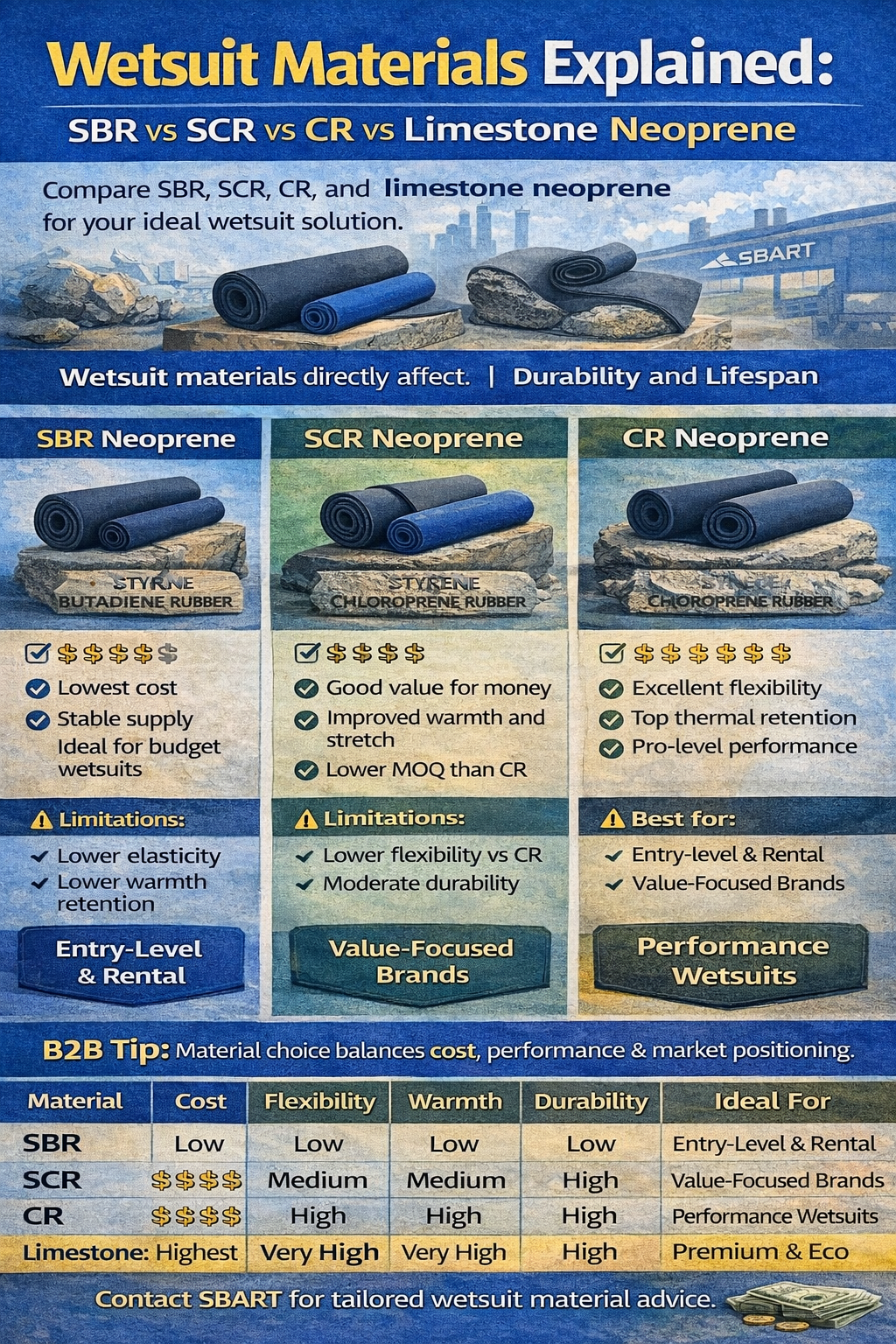
| Material | Cost | Flexibility | Warmth | Durability | Market Level |
|---|---|---|---|---|---|
| SBR | Low | Low | Low | Low | Entry |
| SCR | Medium | Medium | Medium | Medium | Mid |
| CR | High | High | High | High | Performance |
| Limestone | Highest | Very High | High | High | Premium |
How B2B Buyers Should Choose the Right Material
Ask these questions before deciding:
-
What is the target retail price?
-
Is this product for beginners or experienced users?
-
Is eco-positioning part of the brand strategy?
-
Is flexibility or durability more important?
The right material is not the “best” one—it’s the one that fits your business model.
How SBART Supports Material Customization
SBART offers:
-
Full SBR / SCR / CR / limestone neoprene options
-
Clear material cost breakdowns
-
Performance-based material recommendations
-
Stable sourcing for long-term supply
This ensures brands select materials that support margin, quality, and scalability.
Final Thoughts
Material choice defines your wetsuit’s performance, price, and perception.
Smart B2B buyers don’t chase the most expensive option—they choose the most suitable one.
Looking for expert guidance on wetsuit material selection?
Contact SBART to discuss your target market and sourcing strategy.