In today’s competitive wetsuit market, brands must carefully balance cost control, product quality, and speed to market.
Choosing between OEM and ODM wetsuit manufacturing is one of the most critical decisions in this process.
However, OEM and ODM are often misunderstood. Based on real manufacturing practice in the wetsuit industry, this article explains how each model works — and how brands can use them strategically to scale their business.
Understanding OEM and ODM in Wetsuit Manufacturing
In practical B2B manufacturing terms:
-
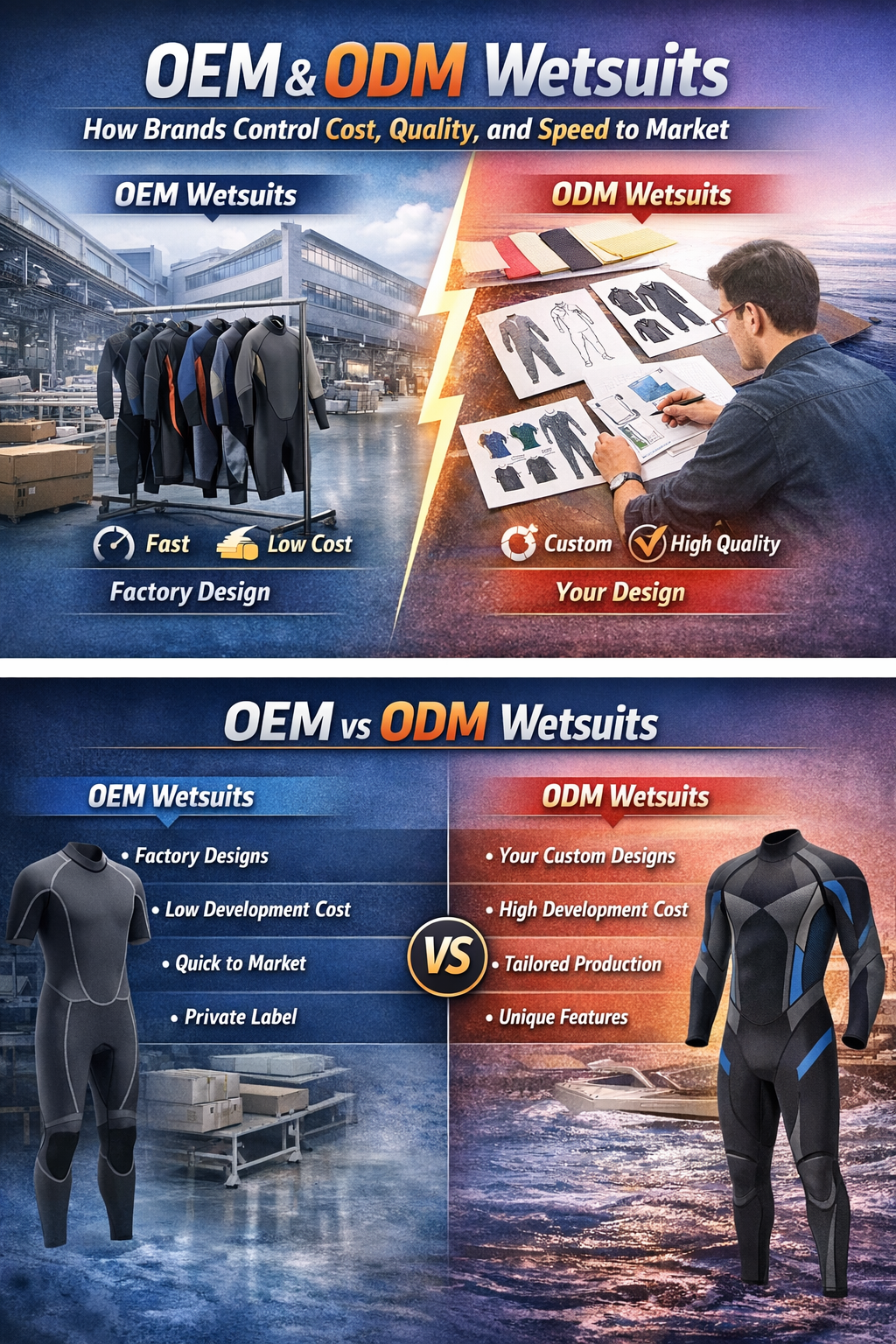
OEM wetsuits: Factory-designed wetsuits with customer branding
-
ODM wetsuits: Customer-designed wetsuits manufactured by the factory
This distinction directly impacts development cost, production efficiency, and brand differentiation.
OEM Wetsuits: Faster Market Entry with Lower Development Cost
OEM (Original Equipment Manufacturer) wetsuits are based on factory-developed designs and patterns. Brands select existing models and apply their own branding.
How OEM Controls Cost
-
No need for full product development
-
Proven patterns reduce trial-and-error costs
-
Materials and construction methods are already optimized
How OEM Ensures Stable Quality
-
Designs have been tested through repeated production
-
Established sizing, stitching, and seam structures
-
Lower risk of performance issues
How OEM Accelerates Speed to Market
-
Shorter sampling cycle
-
Faster production setup
-
Ideal for seasonal launches and fast-moving markets
OEM Wetsuits Are Ideal For:
-
New wetsuit brands
-
Distributors and wholesalers
-
E-commerce and private label sellers
-
Brands testing new markets or product categories
OEM allows brands to enter the market quickly while keeping costs predictable.
ODM Wetsuits: Full Design Control and Product Differentiation
ODM (Original Design Manufacturer) wetsuits are developed based on the customer’s own design, structure, or technical concept.
The factory focuses on manufacturing execution and quality control.
How ODM Supports Brand Differentiation
-
Custom panel layout and fit
-
Unique thickness mapping
-
Proprietary seam construction
-
Brand-specific performance requirements
Cost Considerations in ODM
-
Higher upfront development cost
-
Sampling and testing phases required
-
Long-term value through exclusive products
Quality Control in ODM Projects
-
Customer-defined quality standards
-
Custom material selection (SBR / SCR / CR neoprene)
-
Controlled tolerances and performance benchmarks
ODM Wetsuits Are Ideal For:
-
Established wetsuit brands
-
Surf, dive, and water sports specialists
-
Brands with patented or proprietary designs
-
Long-term product line development
ODM enables brands to build technical barriers and long-term brand value.
OEM vs ODM: Strategic Comparison
| Factor | OEM Wetsuits | ODM Wetsuits |
|---|---|---|
| Design ownership | Factory | Brand |
| Development cost | Lower | Higher |
| Customization level | Low–Medium | High |
| Time to market | Fast | Moderate |
| Product uniqueness | Limited | High |
| Best use case | Market entry & scaling | Brand differentiation |
Choosing the Right Model at Different Brand Stages
Many successful wetsuit brands use both OEM and ODM strategically:
-
OEM for:
-
Entry-level wetsuits
-
Promotional or seasonal products
-
Rapid market expansion
-
-
ODM for:
-
Core performance products
-
Flagship wetsuit series
-
Long-term brand positioning
-
This hybrid approach helps brands control cash flow while maintaining innovation.
SBART OEM & ODM Wetsuit Manufacturing Support
At SBART, we support both OEM and ODM wetsuit manufacturing models, allowing brands to scale flexibly.
OEM Wetsuit Services
-
Factory-developed wetsuit templates
-
Private label branding
-
Flexible MOQ options
-
Fast sampling and delivery
ODM Wetsuit Services
-
Full custom wetsuit development
-
Advanced neoprene options
-
Multiple seam and construction methods
-
CE-compliant production standards
Final Insight
OEM wetsuits help brands win on speed and cost
ODM wetsuits help brands win on performance and differentiation
Understanding how to apply OEM and ODM correctly allows wetsuit brands to optimize resources, reduce risk, and grow sustainably in global markets.
If you’re planning your next wetsuit project, choosing the right manufacturing model is the first step toward success.