
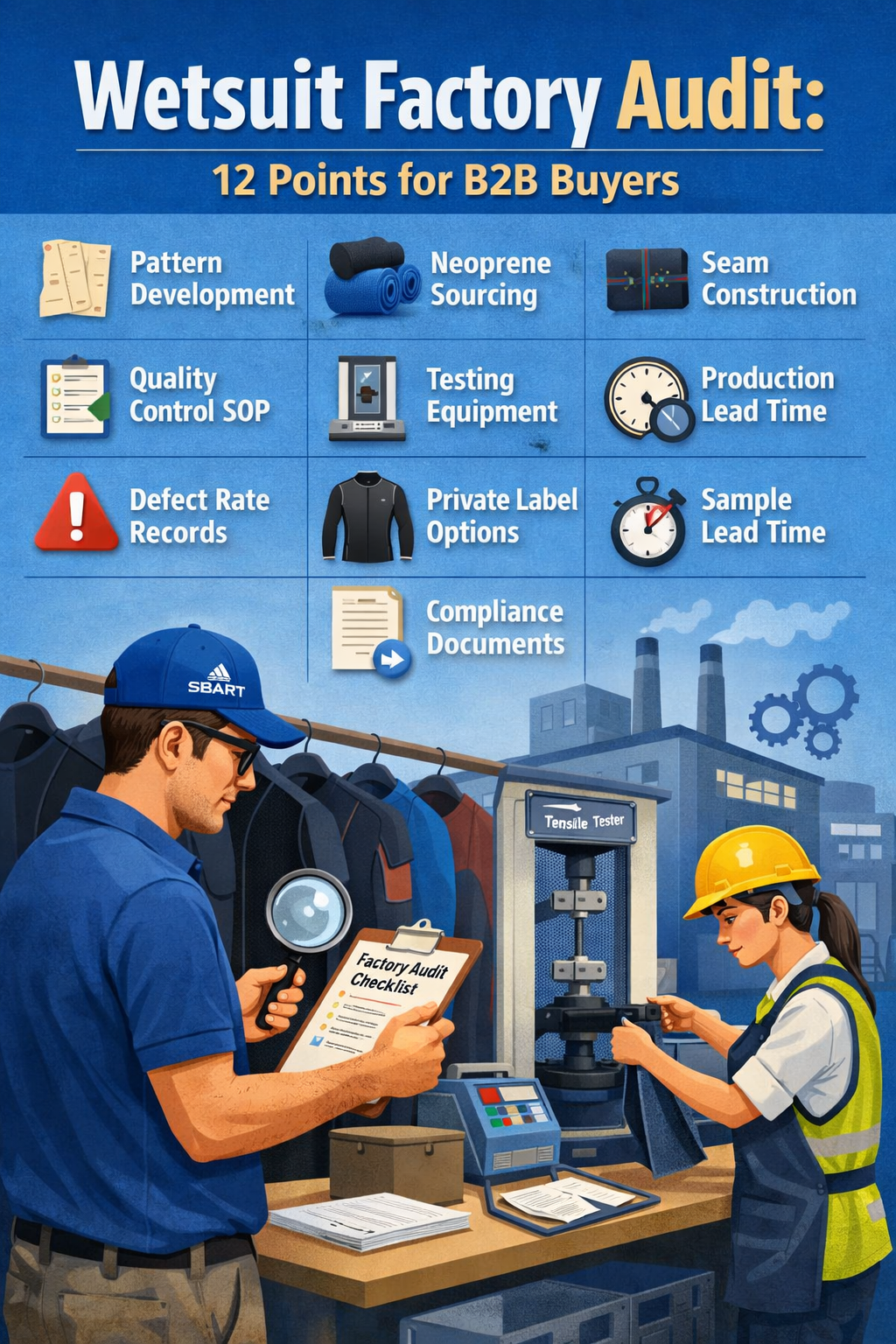
Selecting a wetsuit factory is not about finding the lowest price — it is about finding a supplier that can consistently protect your brand, margins, and delivery commitments.
Below is a practical factory audit framework used by experienced wholesalers, brand owners, and importers.
Why Factory Audits Matter for B2B Buyers
A wetsuit order typically locks your capital for 60–120 days. One mistake in material sourcing, workmanship, or quality control can lead to:
-
High defect rates
-
Missed sales seasons
-
Rebranding or recall risks
-
Lost distributors or retail partners
Factory evaluation is a profit decision, not just a quality check.
The 12 Critical Audit Points
1. Pattern Development Capability
A reliable factory should have an in-house pattern room. Ask to see digital pattern files and physical grading samples for different sizes.
2. Neoprene & Fabric Sourcing
Confirm where neoprene, linings, and laminations are sourced. Stable suppliers guarantee thickness tolerance and elasticity consistency.
3. Lamination & Cutting Accuracy
Check whether lamination is outsourced or controlled in-house. Inspect cutting tables for repeatability.
4. Seam Construction Lines
Verify the presence of GBS, blind stitch, flatlock, and taping lines. Multi-line capacity indicates flexible production capability.
5. Adhesive & Bonding Process
Low-VOC glue and controlled curing temperature directly affect seam durability.
6. Quality Control SOP
Request their QC checklist. A professional factory should inspect materials, in-line sewing, and final packaging separately.
7. Fabric Testing Equipment
Look for stretch recovery testers, abrasion machines, and wash simulation equipment.
8. Sample Lead Time
Ask how long it takes to develop a new wetsuit sample. Industry benchmark is 7–14 days.
9. Bulk Production Lead Time
Reliable factories define production schedules clearly and provide weekly order updates.
10. Defect Rate Records
Ask for last 6 months defect statistics. Anything above 2% should raise concern.
11. Private Label Capability
Confirm support for custom logos, heat transfer, packaging design, and barcode systems.
12. Compliance Documentation
The factory should provide test reports, material MSDS files, and export compliance records for EU & US markets.
Common Red Flags Importers Miss
-
No independent QC department
-
Over-reliance on subcontractors
-
Inconsistent neoprene thickness
-
Unclear ownership of molds and patterns
These issues usually surface after your first bulk shipment — when losses are already locked in.
How SBART Supports Buyer Audits
SBART provides complete factory audit documentation including material traceability, in-house testing data, QC SOP manuals, and production scheduling transparency — allowing wholesale buyers to evaluate risks before committing to volume.
Final Checklist Before Placing Your First Order
-
Pattern room verified
-
Material suppliers documented
-
QC system reviewed
-
Sampling lead time confirmed
-
Defect rate benchmarked
These five checks alone eliminate over 70% of supplier risk.